I grew up in London in the 1960s—an exciting time and place to be a teenager. I studied, experimented with sex, drugs, and rock ‘n roll, and grew my hair …

It’s been quite a journey since then. The text and images on this page document some of the landmarks, and how the haircuts have reflected the zeitgeist of the decades I’ve lived through.
I’ve always loved books, and I wanted to be a writer, but I began hammering on a piano and composing tunes …
… and I got diverted into writing music rather than words.*
* and thank goodness for the diversion. It’s far more challenging to make a decent income from writing books than from composing music for TV.
Perhaps I could have carved out a career as a writer, but I doubt I’d have the good fortune to be living here in las Islas Afortunadas (the “Fortunate Islands”, as the Canaries are called), free to write whatever takes my fancy.
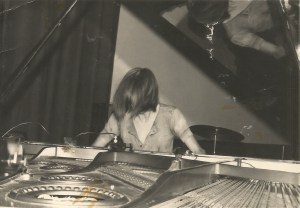
I left home as soon as I could, to study a variety of useless subjects, and by the mid-1970s I had a degree in philosophy, my hair had reached it’s zenith, and I was playing keyboards in jazz, rock, and soul bands …


By the 1980s, I had an M. Phil in electronic music, the hair had got shorter …
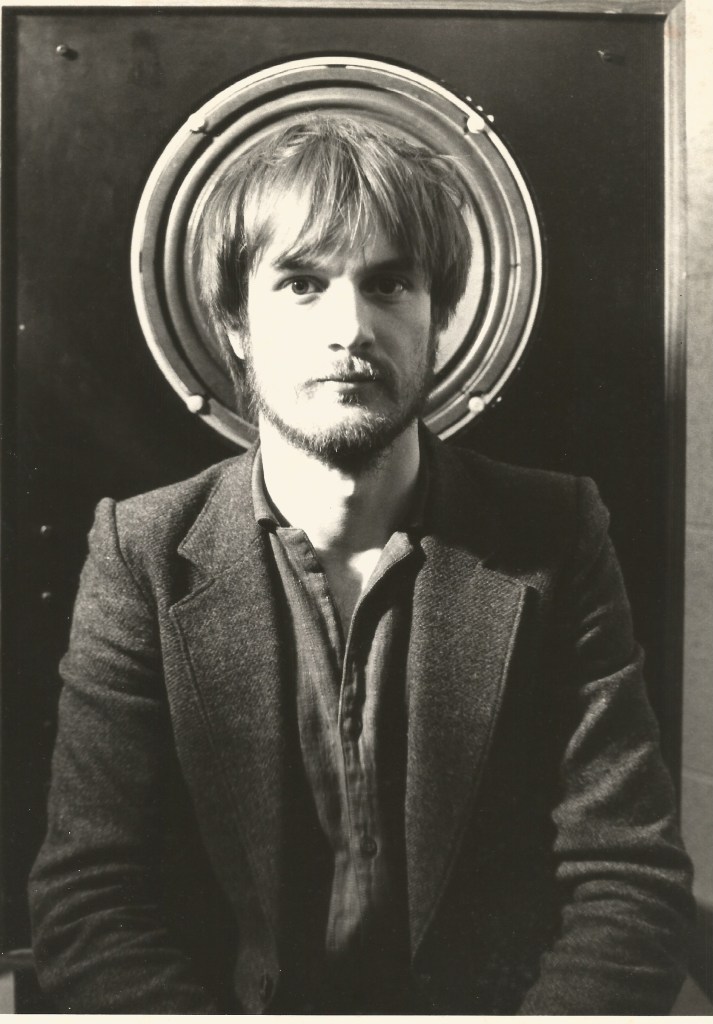
… and I was making my living as a composer of music for radio and TV, working at the BBC’s renowned Radiophonic Workshop (see my entry in Wikipedia) …

While at the BBC, I received two Sony Awards (the BAFTAs of radio) for ‘the Most Creative Use of Radio’…
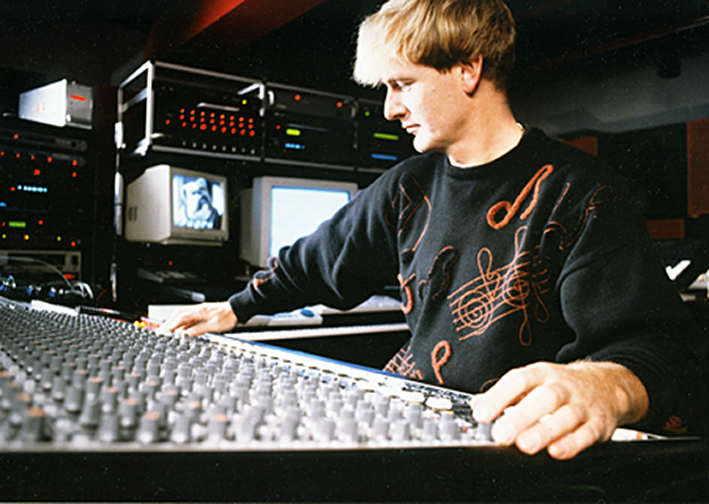

Here I am in 1988, in an extract from A Week in the Life of the Radiophonic Workshop, explaining how I produced a disco track for a BBC schools radio series, using a “state-of-the-art” Mac computer …
Despite the dated sounds and cheesy Miami Vice disco-funk, the process of developing a musical idea from scratch is still relevant (and the haircut is definitely an improvement on the 70s version).
In 1996, the BBC closed the Radiophonic Workshop. I went freelance and left London for the Berkshire countryside, then the south coast, and the hair started to disappear …
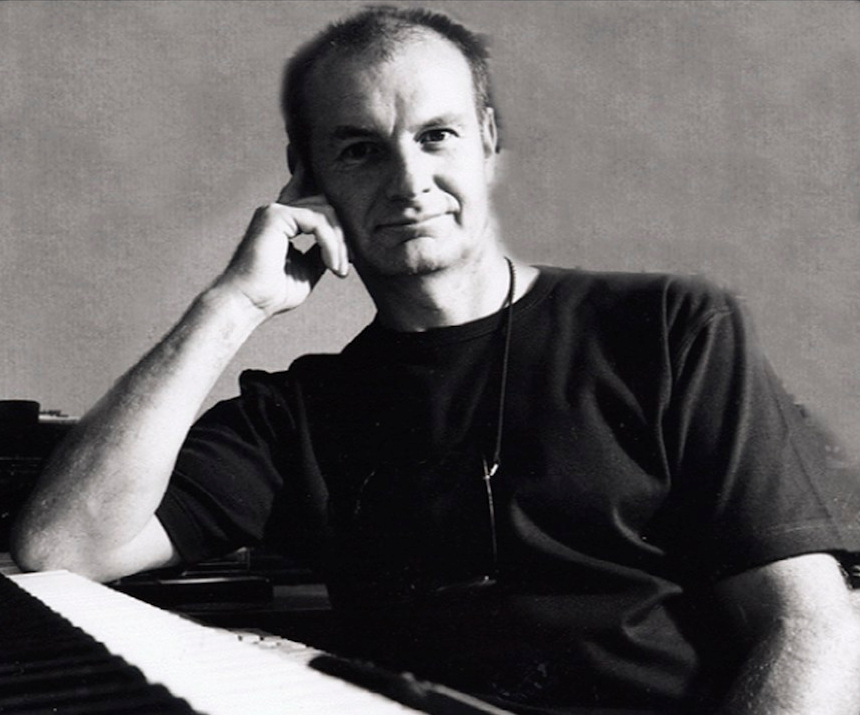

… just as it became fashionable for celebrities (e.g. David Beckham) to shave their heads.
Previously, a shaved head was reserved for skinheads, or iconic actors like Yul Brynner, or Telly Savalas (Kojak). In the new millennium it was cool to be bald, like Kelly Slater (arguably the greatest ever surfer), Brian Eno (influential musician and producer), or Homer Simpson (radical thinker and beer lover).
In 2007, I retired from the media music business and downshifted to a sunny, windy, surfy town in Tenerife (one of the Spanish Canary Islands, off the coast of Africa). This gave me the opportunity to get to grips with my first love: writing, while pursuing my other passion: windsurfing, combining them in a series of articles for Boards magazine: Life on the Reef (you can read the articles HERE).

I’ve been a windsurfer for most of my life. Like Nick, the narrator of Too Close to the Wind, the world’s first windsurfing novel, I used to joke that it was my “religion”. It’s certainly an obsession that’s taken me around the world, searching for wind, waves, and adventure.

A few weeks before my 70th birthday, I decided to quit while I was winning. It wasn’t an easy decision. As a surfaholic, quitting was like going cold turkey—but it did, at least, inspire a story, The Last Wave, which won third prize in the 2023 Lorian Hemingway story competition.
Set on the wild west coast of Ireland, it’s about a surfer struggling to come to terms with ageing and searching for something to replace surfing. As he drives to the beach for his last ever dawn patrol, he looks back at the landmark moments in his life: the people, the waves, and the music. The narrator expresses the grief and regrets I felt when I gave up windsurfing.
These days there’s not much hair left …
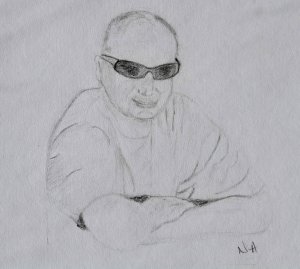
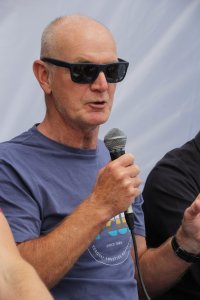
… and I focus on writing.
I’ve published two books co-authored with my wife: Nobody’s Poodle (2013), a novella narrated by an abandoned dog; and Somebody’s Doodle (2016), a fast-moving canine cozy mystery with a heady mix of crime, humour, romance, and a few more dogs.

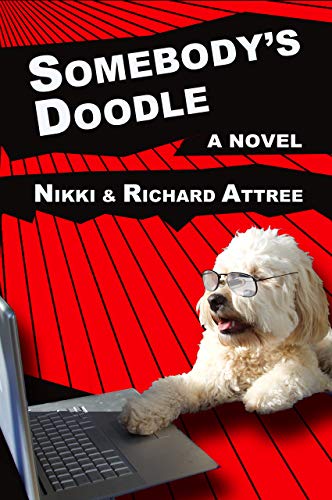
Nobody’s Poodle was included in the Guardian’s Top 50 Readers’ recommended self-published authors, as well as being listed in the Indie Authorland list. Dogs Today Magazine wrote: “I cannot recommend it enough! It’s a real page turner.”
Somebody’s Doodle was highly commended in the 2020 Page Turner Awards.

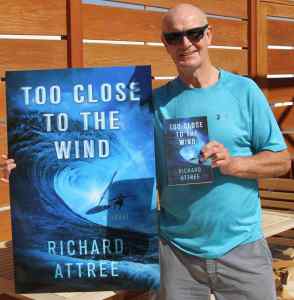
Too Close to the Wind (2019) is my debut solo novel. It’s a journey of self discovery narrated by a young Australian windsurfer: an epic travel adventure, an incredible story of survival, a celebration of wind, surf, and the human spirit … and the world’s first windsurfing novel. Dogs don’t feature in it.

My current novel was inspired by the decades I spent as a professional musician and composer. The Rhythm of Time interweaves the stories of three musicians in 18th, 20th, and 23rd century London. As their parallel timelines unfold, we discover what links them and how music has shaped their lives.
The Rhythm of Time is a musical time machine—a portal into a parallel world where Mozart, Jimi Hendrix, and a 23rd century retrologist rub shoulders. It’s a celebration of the magical phenomenon of music—how it evolves, and yet continues to connect us like nothing else; how it’s the glue that binds a society and makes the unbearable bearable.
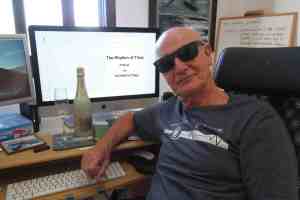
The Rhythm of Time has been long-listed for the Bridport, Yeovil, and Cinnamon Press prizes, chosen as “notable” in the Gutsy Chapter One Prize, and was a finalist in the 2025 Page Turner Awards. I am currently seeking a publisher (watch this space).
As I look back at these landmarks, and reflect on the ebb and flow of Life, the Universe, the Haircuts, and Everything, I’m reminded of the line by Jerry Garcia, the iconic guitarist and founder of the seminal sixties band, the Grateful Dead: “What a long strange trip it’s been.”

Or as Shakespeare puts it, in the famous “All the world’s a stage” speech from As You Like It (which provides the seven part structure for The Rhythm of Time): life is a “strange eventful history.” We’re all “merely players” in a drama with seven acts: the seven ages of man, taking us from the cradle to the grave.
A person’s face is the cover of their book, their life story: This is your Life. The lines etched there show us they’ve lived, laughed, loved and suffered … and their book is worth reading.
The Japanese artist, Hokusai (famous for his Great Wave image, which he painted in his 70s) had an inspiring way of looking at ageing. He said he was a beginner in his 60s, just about getting the hang of drawing in his 80s, and he was looking forward to doing his best work in his 100s.

So, as I make my reluctant entrance in the seventh act of my personal tragicomedy, the biblical “threescore years and ten”, perhaps my journey has just begun?
According to Shakespeare, it’s the final act, so I’d better make the most of it.
Writing is a steep learning curve and we are all students in search of perfection. I’m very fortunate to “live my dream” (to use the jargon of reality TV), here in las Islas Afortunadas. Stories, characters, ideas, and words are my obsession, and my motto is:
Keep Scribbling—and write the story only YOU can write.
 Richard Attree